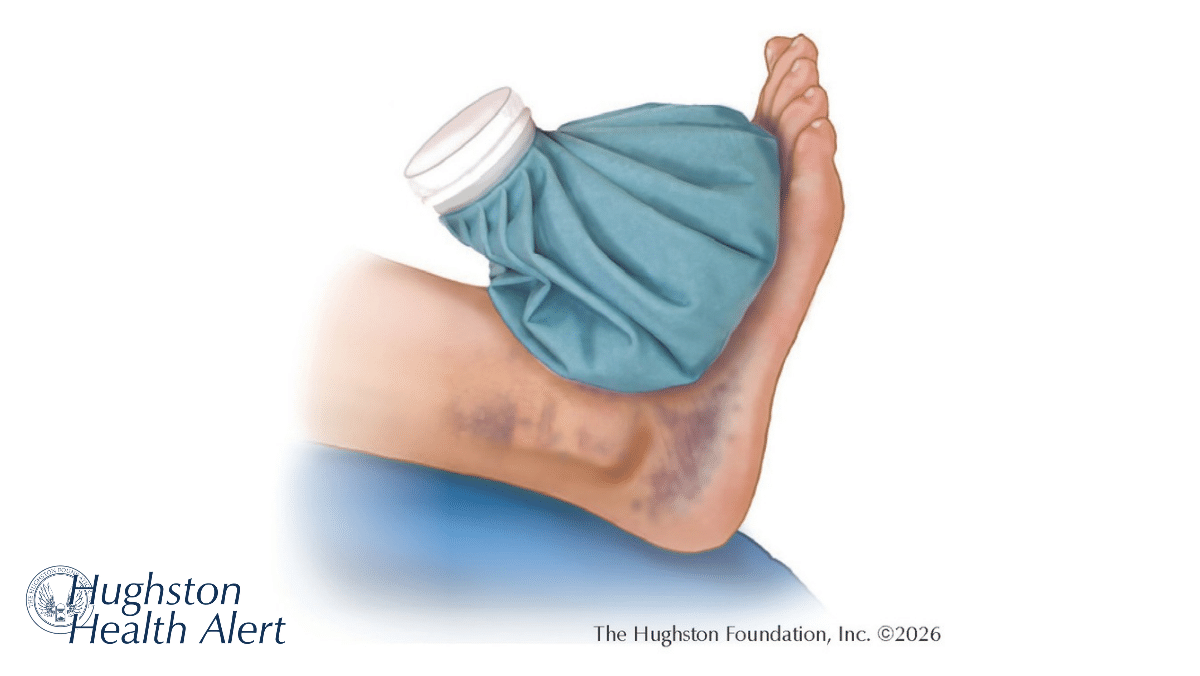
Almost everyone knows that sudden, painful moment: you misstep off a curb, land awkwardly playing backyard basketball, or catch an uneven patch of grass, and your ankle completely gives way. Ankle sprains are among the most common musculoskeletal injuries in the world, and they affect people of all ages. But what exactly happens when you twist your ankle, and how do you ensure a full and proper recovery?
Ankle anatomy
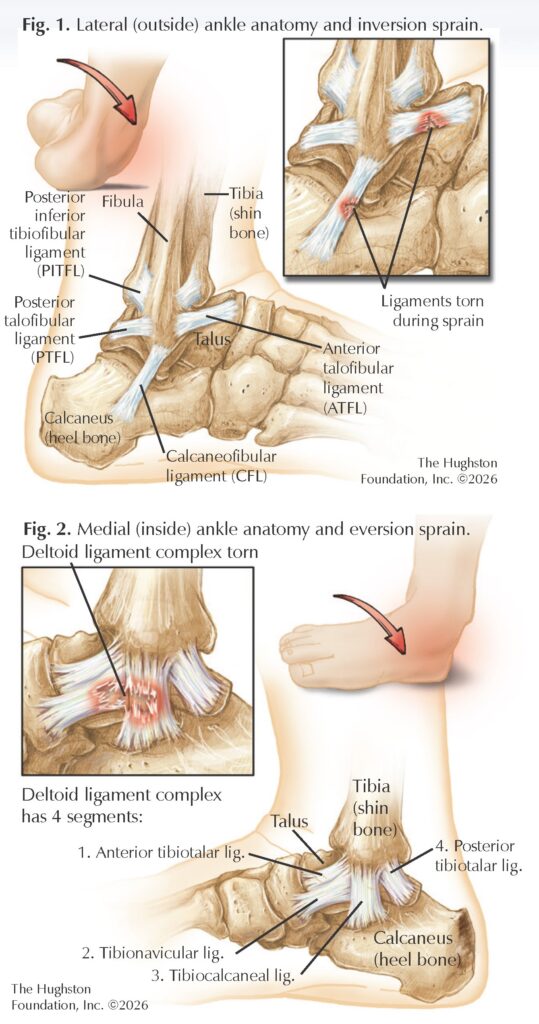
To understand ankle sprains, it helps to review ankle anatomy. Three bones make up the ankle joint: the tibia (shin bone), the fibula (smaller bone of the lower leg), and the talus (small ankle bone). Ligaments are strong, dense, rubber-band-like tissues that connect bones and stabilize your joints. The lateral (outside) ankle has 5 ligaments—the anterior talofibular (ATFL), anterior inferior tibiofibular (AITFL), calcaneofibular (CFL), posterior talofibular (PTFL), and the posterior inferior tibiofibular (PITFL) (Fig. 1). The medial (inside) ankle has the deltoid ligament complex, which is composed of 4 ligaments (Fig. 2). A sprain occurs when you stretch a ligament beyond its limits.
Common injuries
The most common ankle sprain, an inversion sprain, occurs when the foot rolls inward, forcing your body weight onto the outside of the foot. Another type of sprain is an eversion, which occurs when the foot rolls outward, forcing your body weight onto the inside of the foot. If stretched too far or with enough force, the ligaments can tear, resulting in a more serious injury.
A high-ankle sprain involves injury to the ligaments that connect the tibia and fibula, just above the ankle. Together, the ligaments—the AITFL, the PITFL, and the intraosseous membrane are called the syndesmosis. These ligaments maintain the special relationship between the tibia and fibula, creating stability for the talus. High-ankle injuries often occur during a forceful twisting motion when the foot flexes upward.
Who is at risk?
Ankle sprains do not discriminate, but they often affect athletes after a twisting, inversion injury. Ankle sprains account for an estimated 15% of all sports injuries.1 Sports most commonly associated with ankle sprains involve frequent jumping or rapid changes in direction, such as football, soccer, basketball, and volleyball. Despite news headlines, though, half of the 2 million annual sprains do not occur during sports or physical activity.2 Regardless of sport participation, ankle sprains tend to occur more often in females than in males.3
Figuring it out
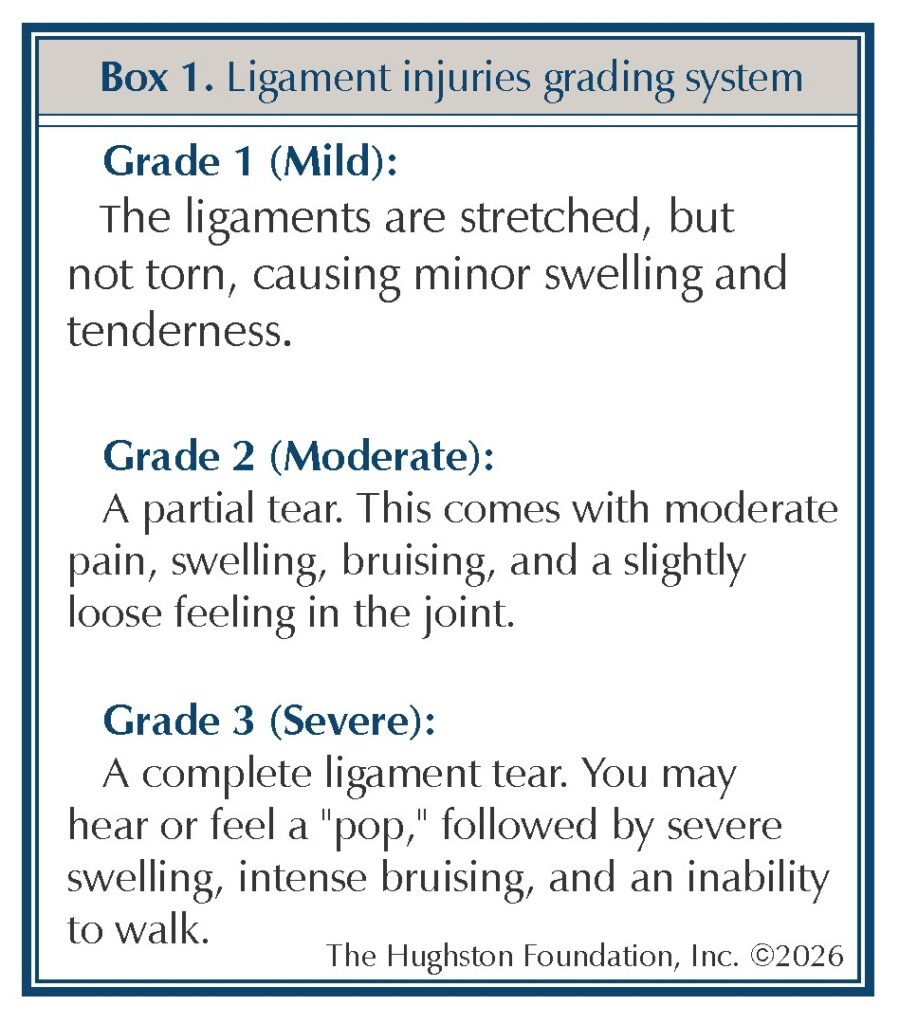
Range of motion, ability to bear weight and walk, and pain with palpation (pressing) of the ankle ligaments are the most common indicators of a sprain. Most patients injure their ligaments in a stepwise manner rather than all at once. Typically, the ATFL, the weakest of the ligaments, is injured first, followed by the CFL, and finally the PTFL. Orthopaedists grade ligament injuries from minor, Grade 1, to severe, Grade 3 injuries (Box 1).
Physicians diagnose an ankle sprain by carefully reviewing the patient’s account of the injury and performing a physical exam of the lower leg, foot, and ankle. Physical exam findings useful in diagnosing a high-ankle sprain include limited ability to ambulate due to pain, as well as pain when squeezing the tibia and fibula together. If a patient has pain with palpation of the medial or lateral malleolus (inside or outside of the ankle bony prominences) or is unable to bear weight on the ankle, an x-ray is needed to ensure that there is no fracture. Diagnosis of a syndesmosis injury can also involve additional standing x-rays or stress views, in which the foot is manipulated dynamically to evaluate the relationship of the tibia, fibula, and talus. If there is continued concern, or your symptoms do not improve over time, your doctor may order an MRI to evaluate the ankle ligaments and other soft tissues in more detail.
Getting back on your feet
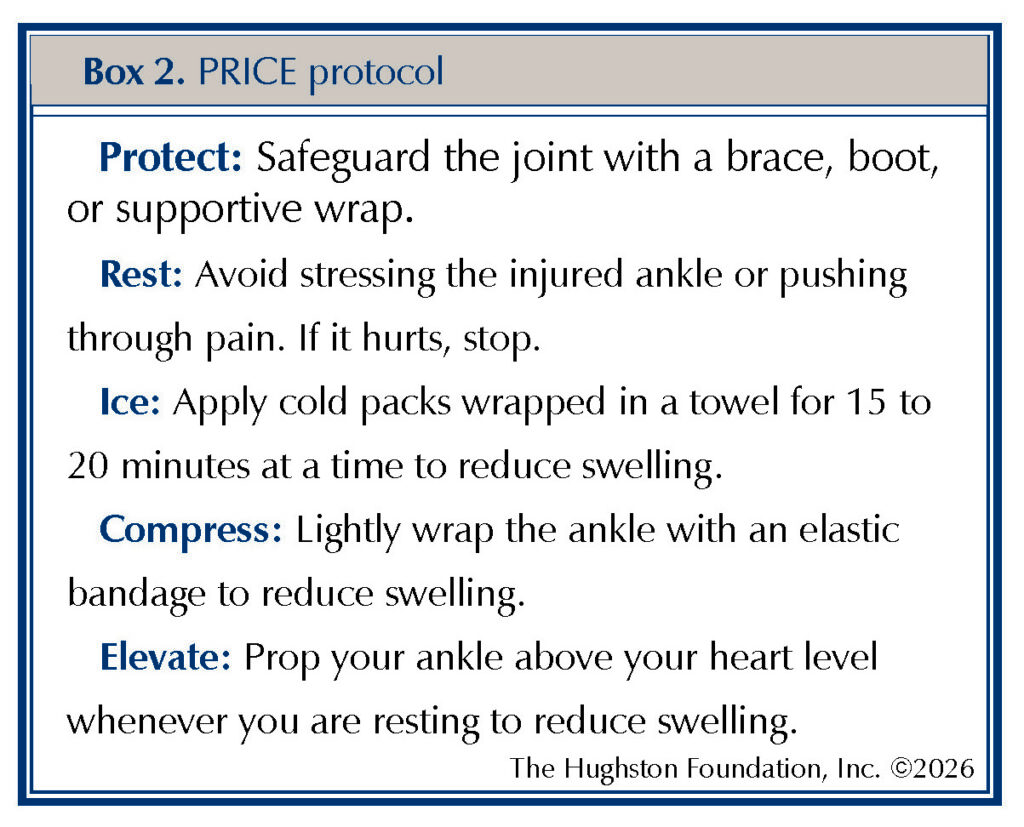 For most mild to moderate sprains, treatment begins with the simple, time-tested PRICE protocol during the first few days after injury (Box 2).
Over-the-counter anti-inflammatories, such as ibuprofen, can help manage the initial pain. As swelling improves over the coming days, early rehabilitation is crucial. Simple exercises, like tracing the alphabet with your toes, standing on one foot, balance balls, and eventually progressing to single-leg hops, help restore balance, strength, and proprioception (the ability to sense your foot’s positioning in space).
Doctors often treat high-ankle sprains conservatively; however, the injury typically requires a longer period of immobilization and nonweightbearing than low ankle sprains, generally 2 to 3 weeks. You should avoid weightbearing until you can apply weight without pain.
Surgical treatment
Your doctor may recommend surgery if your ankle sprain does not improve with conservative care. For athletes, surgery does not guarantee a quicker return to play.4 Some studies show that platelet-rich plasma injections can shorten an athlete’s return to play, but it is important to discuss all treatment options with a sports medicine doctor or an orthopaedic surgeon before making a decision about your care. Surgical treatment could involve using sutures to brace/augment ligaments while they heal or using tissue graft to reconstruct the ligaments.
Avoiding Injury
In everyday life, avoiding ankle sprains can be as simple as carefully watching foot placement while walking on uneven surfaces or during daily activities. Ensuring solid footing and wearing supportive footwear are also simple measures that can prevent an ankle sprain. Additionally, proprioception and balance training can decrease the incidence of ankle sprains, especially in athletes.5
What to watch out for
Treating an ankle sprain as “just a twisted ankle”, pushing through pain, and skipping rehabilitation can lead to long-term issues. The most common complication is chronic ankle instability, where stretched, weakened ligaments leave the ankle loose and prone to repeated injuries. Each subsequent sprain further destabilizes the joint, significantly increasing the risk of osteoarthritis (wear-and-tear arthritis) and chronic ankle pain later in life. After an injury, taking time to rest and rebuild your ankle stability is the best way to protect your long-term mobility.
Author: Jacob Malmquist, MD | Columbus, Georgia
Further reading:
- Swenson DM, Collins CL, Fields SK, Comstock RD. Epidemiology of U.S. high school sports-related ligamentous ankle injuries, 2005/06-2010/11. Clin J Sport Med. 2013 May;23(3):190-6.
- Waterman BR, Owens BD, Davey S, et al. The epidemiology of ankle sprains in the United States. J Bone Joint Surg Am. 2010 Oct 6;92(13):2279-84.
- Doherty C, Delahunt E, Caulfield B, et al. The incidence and prevalence of ankle sprain injury: a systematic review and meta-analysis of prospective epidemiological studies. Sports Med. 2014 Jan;44(1):123-40.
- Salameh M, Hantouly AT, Rayyan A, et al. Return to Play After Isolated Syndesmotic Ligamentous Injury in Athletes: A Systematic Review and Meta-analysis. Foot Ankle Orthop. 2022 May 16;7(2):24730114221096482.
- Cumps E, Verhagen E, Meeusen R. Efficacy of a sports specific balance training programme on the incidence of ankle sprains in basketball. J Sports Sci Med. 2007 Jun 1;6(2):212-9.
Last edited on October 13, 2026