Contributing physicians in this story
Ultrasound provides a quick, safe, cost-effective technique for image-guided musculoskeletal injections. Physicians can perform injections in clinic with little to no additional cost to the patient and can significantly improve accuracy and precision compared with landmark-based (blind) injections. Studies also show higher patient satisfaction with ultrasound-guided joint injections because they cause less pain than blind injections. Ultrasound guidance is now the gold standard for most joint and soft tissue injections; therefore, physicians should use it whenever possible to provide the most accurate injection.
History
Although considered common practice today, physicians have performed musculoskeletal injections for only a little over 75 years, with the first documented joint injection performed in 1950 by a physician at the Mayo Clinic for knee arthritis. Since then, orthopaedists have increasingly used injections to treat or diagnose joint and soft tissue pain and injuries.
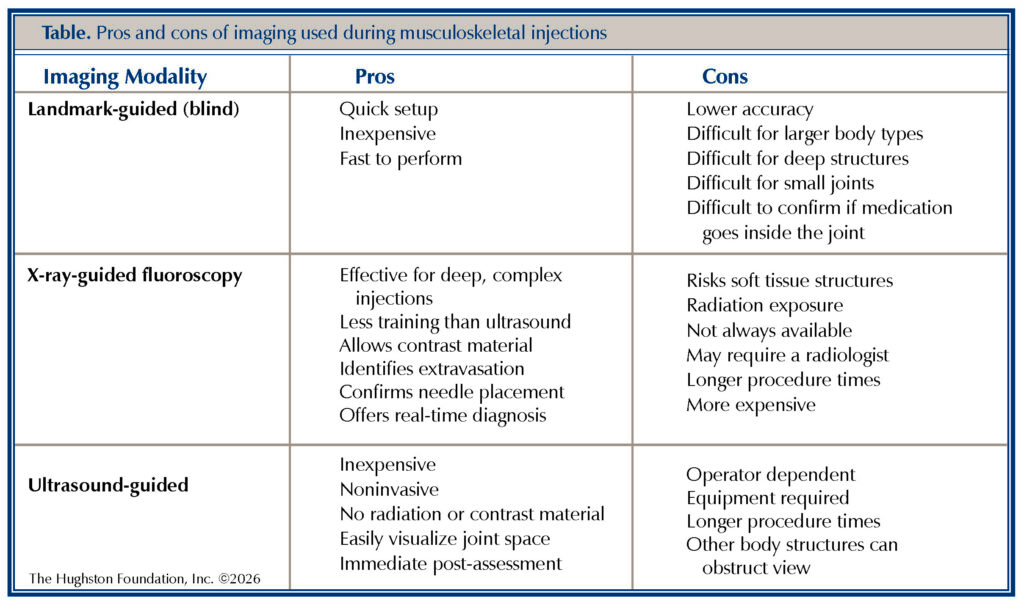
Physicians have historically performed injections using their knowledge of anatomy, skills learned from those who came before them, and by identifying the location of maximal tenderness. With this knowledge and skill, doctors have successfully used a technique known as a “blind” injection, and physicians continue to use this treatment protocol today. However, technological advances in the 20th and 21st centuries now allow physicians to use imaging to assist with musculoskeletal injections with much higher accuracy than blind injections. These imaging modalities include options such as x-ray guided fluoroscopy, computerized tomography (CT), magnetic resonance imaging (MRI), and ultrasound (US). Each imaging-guided technique has its own pros and cons, including required training or specialization, availability, cost, radiation, and exposure.¹
Ultrasound availability has steadily increased over the past few decades, following the development of large point-of-care ultrasound (POCUS) systems in the mid-1990s that doctors used primarily in emergency room and obstetric settings. Today, we use small handheld systems. Advancements in ultrasound equipment, coupled with availability, patient convenience, and lower costs, have led to patient preference for ultrasound over other imaging-guided modalities, such as x-ray-guided fluoroscopic procedures. Introduced in 1998, a portable POCUS system, running on battery power alone, weighed about 25 pounds. The first pocket-sized ultrasound was developed in 2007. Today, small wireless ultrasound probes weigh less than a pound, connect to phones and tablets, and can be used anywhere on the planet.
Uses
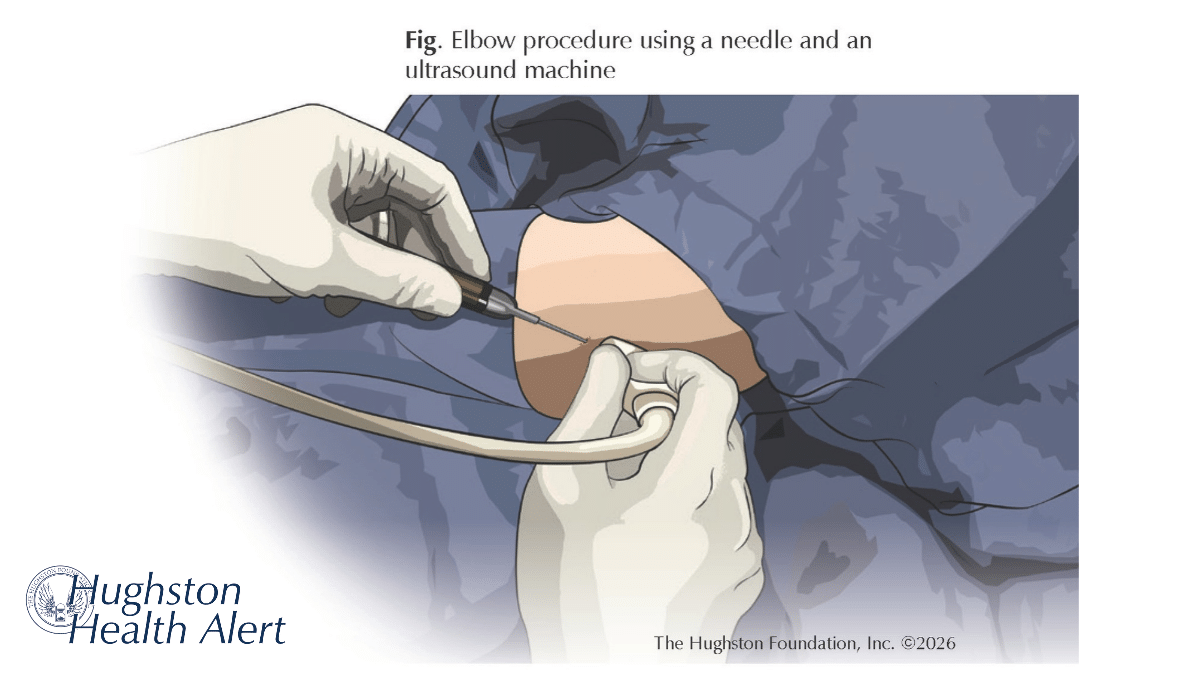
Musculoskeletal injections are among the primary tools physicians use to diagnose and treat orthopaedic conditions (Fig). Doctors use injections for different reasons, such as a steroid injection to control inflammation, a PRP injection to support regeneration and healing, or a hyaluronic acid injection to manage arthritis. Injections play a vital role in managing both acute and chronic conditions and can also serve diagnostic purposes. For example, physicians use numbing agents with medications to serve as a diluting agent as well as to provide some anesthetic pain relief. While the injection provides crucial diagnostic information that confirms the source and location of the pain, any significant pain relief noted in the first 30 to 90 minutes is almost certainly from the anesthetic agent.
Using imaging guidance for musculoskeletal injections can greatly increase accuracy and effectiveness. Of the currently available imaging-guided injection options, ultrasound is the quickest, safest, most cost-effective option, and it requires little to no additional training to use. With these advantages, ultrasound guidance has become the gold standard for many musculoskeletal injection treatments.
Procedure
A licensed health professional often performs ultrasound-guided injections in clinic during the scheduled office visit. The doctor will explain the procedure and obtain consent; the staff will prep and drape the treatment area the same way they would a blind injection. During an ultrasound-guided injection, however, an ultrasound machine will be set up next to the bed to allow visualization of anatomic structures during the procedure. An ultrasound probe and gel provide a medium for radiation-free sound waves to travel through the tissues. The waves bounce off anatomic structures and provide feedback through the ultrasound probe, which the machine interprets to produce a real-time image of the structures beneath the probe. This allows visualization of structures that are both static (still) and dynamic (live), as well as the needle during the procedure, leaving little to no doubt that the injection is in the desired structure or space. During the procedure, the doctor saves the images to the ultrasound machine and uploads them to an imaging database for future review, if necessary. Once the procedure is complete, the doctor cleans off the ultrasound gel and applies a sterile bandage.
Outcomes
Studies have repeatedly shown increased accuracy of ultrasound-guided injections compared to blind injections, especially for small joints such as fingers and toes and medium-sized ankle and wrist joints. Some studies have shown similar accuracy for large joints such as the shoulders and knees between blind and ultrasound-guided injections, while others clearly show ultrasound-guidance superiority for all joint injections. Hip joints specifically have demonstrated low accuracy with blind injections (approximately 70%) compared to ultrasound-guided injections (approximately 97%). There are few, if any, studies that demonstrate superiority of landmark-based (blind) injection techniques when compared to ultrasound-guided techniques (Table).
Conclusion
Ultrasound usage for injections is a relatively new technique that can provide increased accuracy while potentially allowing for decreased pain. Patients often prefer it over fluoroscopically guided injections because of its convenience and lower cost. When available, ultrasound-guided musculoskeletal injections provide a clear advantage in accuracy compared with non-imaging injections.
Author: Edgar J. Dollar II, DO | LaGrange, Georgia
Reference:
- Saha P, Smith M, Hasan K. Accuracy of intraarticular injections: blind vs. image guided techniques—A review of literature. Journal of Functional Morphology and Kinesiology. 2023;8(93):1-13.
Last edited on October 13, 2026